C++'s std::vector, but relocating data is cheap(er)
Table of contents
This is sort of in a similar theme in the previous post, where I talked about
the std::move behavior under std::vector’s resizing. I stumbled upon a
YouTube comment that mentioned an idea about resizing vectors but you don’t
have to actually move the data contents. Unfortunately, that was few months ago,
and I already lost the link. I just happened to have the time to try out this idea.
The idea#
In high level, everything that is running under a process are done using virtual memory addressing space. Those contiguous arrays are only contiguous in virtual memory space, but not necessarily in physical memory space.
std::vector<int> v = {A, B, C, D, E, F, G, H};
v.data(); // 0x1000

Memory layout (virtual):
         0x0  0x2  0x4  0x6  0x8  0xA  0xC  0xE
0x1000:   A    B    C    D    E    F    G   H

Physical memory layout (assume 1 frame holds 8 bytes/4 ints):

Frame 0x3A000:   A    B    C    D
Frame 0x3A001:   E    F    G    H

Virtual -> Physical mapping:
0x1000 -> Frame 0x3A000
0x1008 -> Frame 0x3A008
The physical memory addresing works in frames/pages. Commonly, each page holds 4096 bytes (4 KB). This is configurable depending on what the operating system and CPU supports. It makes them easier to manage the memory and avoid fragmentation. In order to convert a virtual address to a physical address, the operating system uses a page table. The page table basically is just a map for that virtual address space to the actual physical memory address, and that is transparent to the user.
Resizing#
std::vector resizes itself by allocating a new memory segment longer than the current one,
moving the data to the new segment, and then freeing the old segment. This is done to keep the
data contiguous. Since they are mapped to a physical pages and in the physical space, they are
not contiguous anyway, we can actually just “allocate the additional segment needed”, and “update
the mappings of the old segment”.
std::vector<int> v = {A, B, C, D, E, F, G, H};
v.data(); // 0x1000

Memory layout (virtual):
         0x0  0x2  0x4  0x6  0x8  0xA  0xC  0xE
0x1000:   A    B    C    D    E    F    G    H

Virtual -> Physical mapping:
0x1000 -> Frame 0x3A000
0x1008 -> Frame 0x3A008

Push extra data: {I, J, K, L}, extends vector by 4
- Remap the virtual address 0x1000 to fit 12 bytes
  - Reserved additional page in physical address 0x3B000
- Virtual mapping now updates to
  - 0x5000 -> Frame 0x3A000
  - 0x5008 -> Frame 0x3A008
  - 0x5010 -> Frame 0x3B000 (Our new page)

Now, virtual memory layout is now:
Memory layout (virtual, x is uninitialized data, usually zero):
         0x0  0x2  0x4  0x6  0x8  0xA  0xC  0xE
0x5000:   A    B    C    D    E    F    G    H
0x5010:   x    x    x    x

Push {I, J, K, L} as usual.
Notice that we don’t have to move the data, because the virtual address maps to the same physical pages as before.
Linux’s mremap#
Linux provides a system call which does that exactly: mremap which allows to remap a memory mapping to shrink/enlarge the size.
The code#
Welp, enough talk, I just want to prove whether the idea works anyway.
#include <sys/mman.h>
#include <utility>
#include <math.h>
#include <cassert>
#include <cstring>

namespace virtual_vector {

template <typename T> class VirtualVector {
public:
  VirtualVector() : data_(nullptr), capacity_(0), size_(0) {}
  ~VirtualVector() {
    for (size_t i = 0; i < size_; ++i) {
      data_[i].~T();
    }
    if (data_ != nullptr) {
      munmap(static_cast<void *>(data_), capacity_ * sizeof(T));
    }
  }


  void reserve(size_t capacity) {
    if (capacity <= capacity_) {
      return;
    }

    if (data_ == nullptr) {
      data_ = static_cast<T *>(mmap(nullptr, capacity * sizeof(T),
                                    PROT_READ | PROT_WRITE,
                                    MAP_PRIVATE | MAP_ANONYMOUS, -1, 0));
    } else {
      data_ = static_cast<T *>(mremap(static_cast<void *>(data_),
                                      capacity_ * sizeof(T), capacity * sizeof(T),
                                      MREMAP_MAYMOVE));
    }
    assert(data_ != MAP_FAILED);
    capacity_ = capacity;
  }


  void push_back(T value) {
    if (size_ == capacity_) {
      reserve(std::max(1UL, capacity_ * 2));
    }
    new (&data_[size_++]) T(std::move(value));
  }


  T* data() { return data_; }
  const T* data() const { return data_; }

private:
  T *data_;
  size_t capacity_;
  size_t size_;
};

} // namespace virtual_vector
That’s it… nothing special. We used mmap/munmap/mremap instead of
new/delete to achieve it.
Benchmark#
So to spin up how this thing performs:
static const std::string kStr(64, 'x');

static void BM_VirtualVector_String_PushBack(benchmark::State& state) {
    const int N = state.range(0);
    for (auto _ : state) {
        VirtualVector<std::string> v;
        for (int i = 0; i < N; ++i) v.push_back(kStr);
        benchmark::DoNotOptimize(v.data());
    }
    state.SetItemsProcessed(state.iterations() * N);
}

static void BM_StdVector_String_PushBack(benchmark::State& state) {
    const int N = state.range(0);
    for (auto _ : state) {
        std::vector<std::string> v;
        for (int i = 0; i < N; ++i) v.push_back(kStr);
        benchmark::DoNotOptimize(v.data());
    }
    state.SetItemsProcessed(state.iterations() * N);
}

BENCHMARK(BM_VirtualVector_String_PushBack)->RangeMultiplier(4)->Range(512, 1 << 26);
BENCHMARK(BM_StdVector_String_PushBack)->RangeMultiplier(4)->Range(512, 1 << 26);

struct LargePOD {
    int value;
    char data[1024 - sizeof(int)];
};

static void BM_VirtualVector_LargePOD_PushBack(benchmark::State& state) {
    const int N = state.range(0);
    for (auto _ : state) {
        VirtualVector<LargePOD> v;
        for (int i = 0; i < N; ++i) {
            LargePOD p{}; p.value = i;
            v.push_back(p);
        }
        benchmark::DoNotOptimize(v.data());
    }
    state.SetItemsProcessed(state.iterations() * N);
}

static void BM_StdVector_LargePOD_PushBack(benchmark::State& state) {
    const int N = state.range(0);
    for (auto _ : state) {
        std::vector<LargePOD> v;
        for (int i = 0; i < N; ++i) {
            LargePOD p{}; p.value = i;
            v.push_back(p);
        }
        benchmark::DoNotOptimize(v.data());
    }
    state.SetItemsProcessed(state.iterations() * N);
}

BENCHMARK(BM_VirtualVector_LargePOD_PushBack)->RangeMultiplier(4)->Range(512, 1 << 21);
BENCHMARK(BM_StdVector_LargePOD_PushBack)->RangeMultiplier(4)->Range(512, 1 << 21);

BENCHMARK_MAIN();
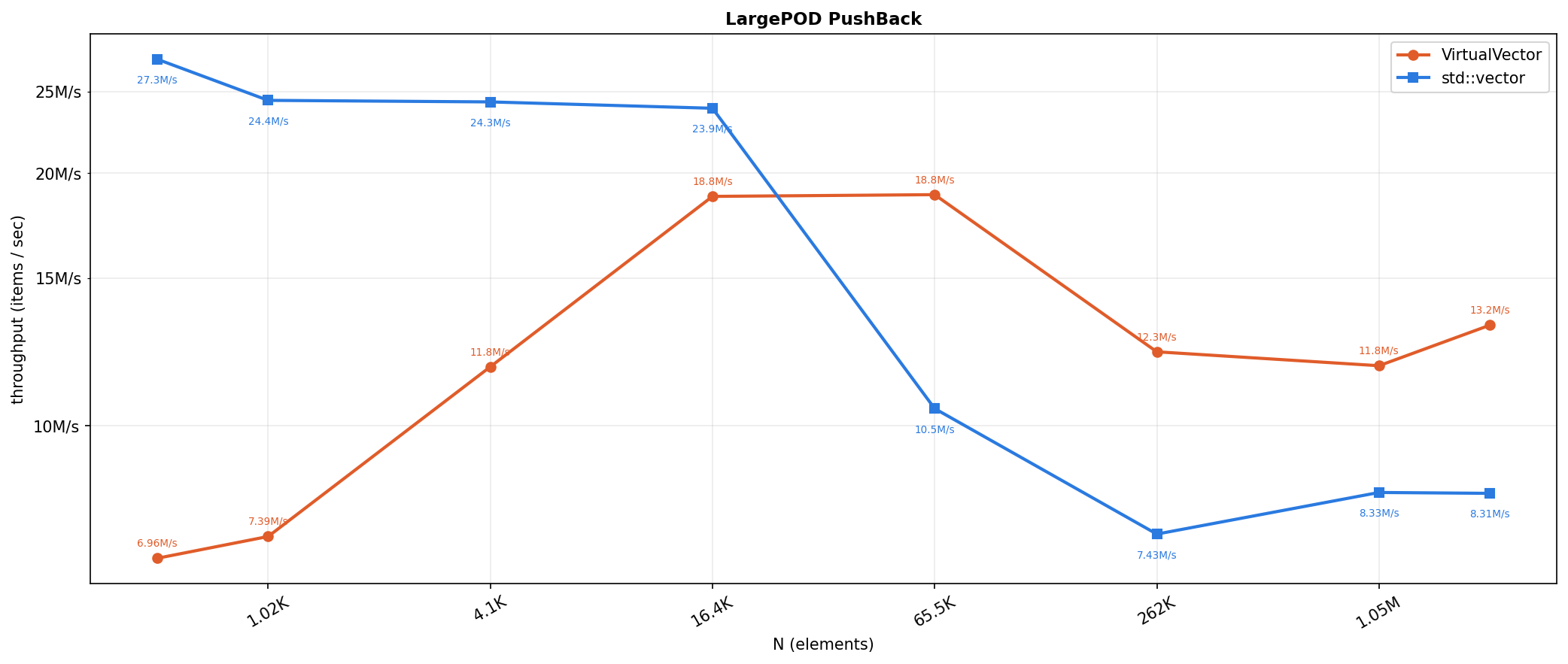
On a vector of large POD/structs (1KB above), it scales pretty well. It was faster than std::vector starting from ~16K elements.
I guess that’s where the relocation exceeds our cache (just a speculation!).
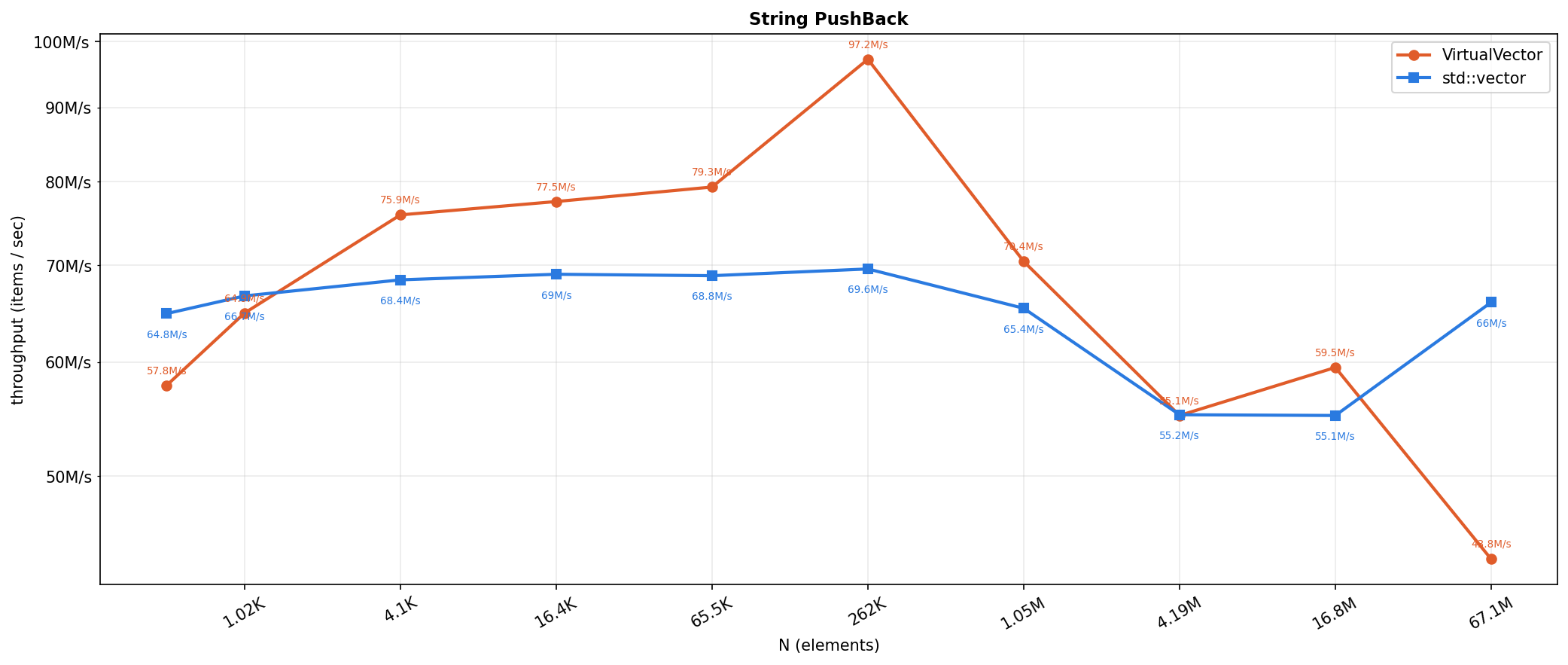
This is where it gets interesting. This is actually illegal since you actually cannot use std::string here due to the reason
I explain later. However, it seemed like the VirtualVector had some advantage until at some point where it goes back to
std::vector (even losing at it!). Perhaps that the mremap overhead and rewriting the page table is getting more expensive
the more pages are remapped.
Worth it?#
This method only works if the containing objects do not contain pointers to somewhere in its own struct. For example,
std::string has a short string optimization where short strings are contained within the std::string struct itself,
and therefore no extra heap allocation. In that case, the ::data() will point to some memory region within the std::struct.
If we remap the address, the pointer is no longer valid.
As far as I could tell from above, this approach is only worth if what you need is a contiguous, dynamic array of large PODs.
Again, these above assumes that you don’t know the final count of the elements. If you know, std::vector::reserve() does
the job very well already.
For me, that is a very niche requirement.